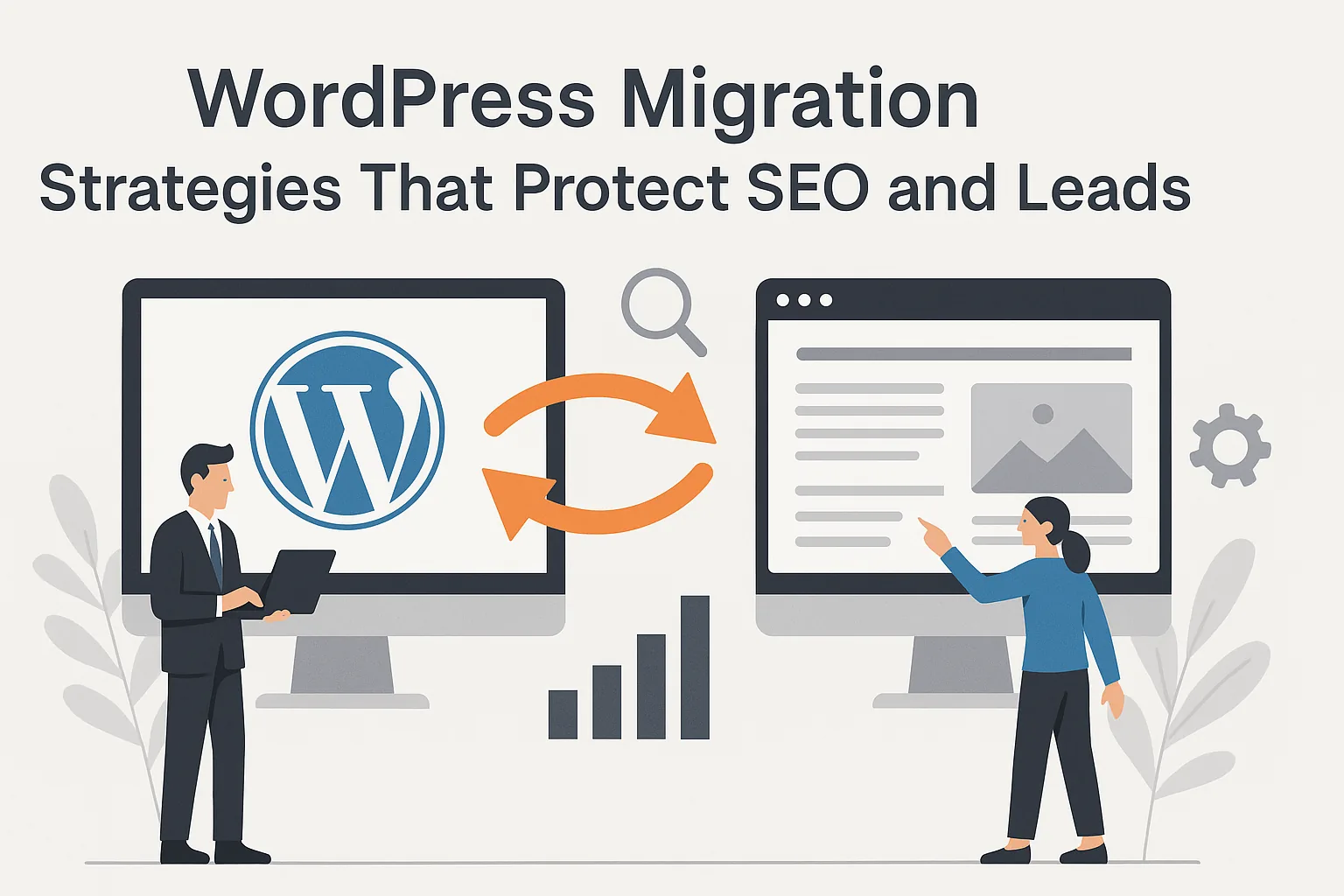
WordPress Migration Strategies That Protect SEO And Leads
A wordpress migration is more than moving files from one server to another. Done right, it preserves rankings, traffic, form submissions, call volume, and every conversion path your business depends on. Done poorly, it can break URLs, erase tracking, slow the site, or cause search engines to treat your new site like an unknown property.
Whether you are moving to a new host, redesigning your site, changing domains, or rebuilding on a new WordPress setup, the goal is the same: protect SEO equity and keep leads coming in.
Why wordpress migration Requires More Than a Technical Move
Many businesses think of migration as a server task. Copy the database, move the theme, update DNS, and go live. That is only part of the process.
A successful wordpress migration protects:
- Organic search rankings
- Indexed pages and URL structure
- Backlinks and referral traffic
- Contact forms and lead routing
- Analytics and conversion tracking
- Page speed and mobile usability
- Calls-to-action and landing page performance
- Local SEO signals
- User trust and brand consistency
The highest-risk migrations usually involve multiple changes at once: new hosting, new design, new content, new URLs, and new tracking. Each change can improve the website, but each also introduces risk. The strategy is to plan carefully, test thoroughly, and launch with safeguards in place.
If your site is also being redesigned or rebuilt, STL Website Development’s custom website development services can help align the technical migration with performance, usability, and lead generation goals.
Start With a Full SEO And Lead Audit
Before touching the site, document what is currently working. This gives you a baseline and helps prevent valuable pages, keywords, and conversion paths from being lost.
Your pre-migration audit should include:
- Top organic landing pages
- Current keyword rankings
- Pages with backlinks
- High-converting service pages
- Contact forms and thank-you pages
- Phone call tracking numbers
- Live chat or scheduling tools
- Analytics goals and events
- Local SEO pages
- Blog posts that generate traffic
- Existing redirects
- XML sitemap and robots.txt rules
Use tools such as Google Analytics, Google Search Console, and your preferred SEO platform to identify high-value URLs. Search Console is especially important because it shows indexed pages, crawl errors, search queries, and performance trends directly from Google.
Do not assume every page has equal value. Some pages may get little traffic but drive qualified leads. Others may attract visitors but not conversions. A smart wordpress migration protects both SEO visibility and business outcomes.
Build a Migration Map Before Development Begins
A migration map is the control document for your project. It lists every existing URL and what will happen to it after launch.
For each URL, define whether it will be:
- Kept exactly the same
- Updated with improved content
- Merged into another page
- Redirected to a new URL
- Removed intentionally
- Noindexed for strategic reasons
This map is especially important if you are changing your site structure. For example, a service page at /services/web-design/ might become /website-development/. Without a proper redirect, visitors and search engines hitting the old URL may land on a 404 error page. That can reduce rankings and waste qualified traffic.
Google provides detailed guidance on site moves in its Search Central documentation for URL changes. The key takeaway is simple: plan URL changes carefully and use permanent redirects where appropriate.
Technical wordpress migration Checklist
A strong technical process reduces downtime, broken functionality, and ranking volatility. Before launch, your development team should work through a complete checklist.
Hosting and server setup
Choose hosting that supports your performance and security requirements. Cheap hosting can create slow load times, frequent downtime, and poor user experience. For lead-generation websites, reliability matters.
Confirm:
- PHP and MySQL versions are compatible
- SSL certificate is installed
- Server caching is configured correctly
- CDN settings are ready if used
- Staging environment is password-protected
- Backups are available before launch
- Email deliverability is not disrupted
Database and media transfer
WordPress sites depend on both files and the database. The database contains content, settings, users, plugin configurations, and form entries. Media files include images, PDFs, videos, and uploads.
During a wordpress migration, confirm that:
- All uploads transfer correctly
- Database URLs are updated safely
- Serialized data is handled properly
- User roles and permissions remain intact
- Form entries are preserved if needed
- Plugin settings transfer correctly
- Image paths are not broken
Theme and plugin compatibility
A migration is a good time to remove bloated or outdated plugins, but do it carefully. Some plugins may power critical features such as forms, redirects, SEO metadata, schema, security, or caching.
Audit plugins for:
- Security risks
- Duplicate functionality
- Abandoned development
- Performance impact
- Compatibility with the new environment
- Business-critical functions
If your existing site has accumulated years of patches and plugin conflicts, professional website maintenance plans can help keep the migrated site stable after launch.
Protecting SEO During wordpress migration
SEO protection starts long before launch and continues afterward. The goal is to help search engines understand that your content has moved, improved, or consolidated—not disappeared.
Preserve high-value URL structure when possible
If a URL ranks well and converts, keep it unless there is a clear reason to change it. Changing URLs adds risk, even when redirects are implemented correctly.
When URL changes are necessary, use 301 redirects from old pages to the most relevant new pages. Avoid redirecting every old URL to the homepage. That creates a poor user experience and sends weak relevance signals.
Migrate metadata and headings
Page titles, meta descriptions, H1s, schema markup, and image alt text all help define page relevance. If you rebuild the site and forget to migrate metadata, rankings can drop even if the visible content looks similar.
Review:
- Title tags
- Meta descriptions
- H1 and H2 structure
- Canonical tags
- Open Graph tags
- Schema markup
- Image alt attributes
- Internal links
This is also a chance to improve weak copy. If your migrated site needs clearer service messaging, benefit-driven headlines, or stronger calls-to-action, STL Website Development’s professional copywriting services can support both SEO and conversion optimization.
Update internal links
Internal links help users navigate and help search engines understand page relationships. After a wordpress migration, scan the entire site for old internal URLs. Update them to point directly to the new destination instead of relying on redirects.
Important internal links include:
- Main navigation
- Footer links
- Service page links
- Blog post links
- CTA buttons
- Breadcrumbs
- Sidebar links
- Image links
Clean internal linking improves crawl efficiency and keeps visitors moving toward conversion.
Generate and submit a fresh XML sitemap
After launch, generate a new XML sitemap and submit it through Google Search Console. The sitemap should include only canonical, indexable URLs. Remove staging URLs, redirected pages, noindex pages, and broken links.
Also check your robots.txt file. A surprisingly common migration mistake is launching with a staging noindex or disallow rule still active. That can block search engines from crawling the new site.
Protecting Leads And Conversion Paths
SEO traffic only matters if visitors can become leads. A wordpress migration should include conversion testing before and after launch.
Test every lead capture point
Do not assume forms work because they appear on the page. Submit test inquiries from desktop and mobile devices.
Test:
- Contact forms
- Quote request forms
- Newsletter signups
- Appointment scheduling
- Click-to-call buttons
- Email links
- Live chat
- Download forms
- Thank-you page redirects
- CRM integrations
- Autoresponder emails
Confirm who receives each notification and whether submissions are logged in the website, CRM, or email platform.
Keep calls-to-action visible
A redesign can accidentally weaken conversions by burying CTAs, removing phone numbers, or making forms harder to find. Review important pages from a user’s perspective.
Ask:
- Is the next step obvious?
- Is the phone number easy to tap on mobile?
- Does each service page have a relevant CTA?
- Are forms short enough?
- Are trust signals visible?
- Are testimonials, badges, or portfolio examples included?
- Does the content answer buyer questions?
Migration is an opportunity for conversion optimization, not just preservation. Better page structure, stronger messaging, faster loading, and clearer CTAs can increase leads without requiring more traffic.
Maintain brand trust
If the migration includes a visual redesign, make sure your brand remains consistent across the website, social platforms, business listings, and sales materials. Confusing or outdated branding can reduce trust.
If your company is refreshing its identity as part of a website project, STL Website Development also provides logo design and brand support to keep the new site professional and consistent.
Tracking, Analytics, And Reporting
A migration without tracking is a blind launch. Before going live, confirm that all analytics and lead tracking tools are properly installed.
Review:
- Google Analytics 4
- Google Tag Manager
- Google Search Console
- Call tracking scripts
- CRM tracking
- Form conversion events
- Paid ad pixels
- Heatmap tools
- Cookie consent tools if applicable
Make sure tracking is tested on the live domain, not just staging. If your thank-you page URLs change, update conversion goals. If forms are rebuilt, update event triggers.
After launch, monitor daily for the first week, then weekly for at least the first month. Look for sudden drops in traffic, indexing issues, crawl errors, page speed problems, and conversion declines.
Launch Day Process for wordpress migration
Launch day should follow a documented sequence. Rushing the final steps is where many mistakes happen.
A clean launch process includes:
- Create a final full backup.
- Confirm staging approval.
- Freeze content changes temporarily.
- Migrate final database and files.
- Update DNS or hosting settings.
- Install and verify SSL.
- Remove staging blocks.
- Test homepage and critical pages.
- Test forms, calls, and tracking.
- Check redirects.
- Submit XML sitemap.
- Monitor crawl errors and uptime.
If possible, launch during a lower-traffic window. For many businesses, that means avoiding Monday mornings, peak sales periods, or active advertising campaigns.
Post-Migration Monitoring
Even with careful planning, search engines need time to process changes. Some ranking fluctuation is normal after a wordpress migration, especially if URLs, content, or site architecture changed.
Monitor these items closely:
- Organic traffic trends
- Keyword rankings
- Indexed page count
- 404 errors
- Redirect chains
- Server errors
- Core Web Vitals
- Form submissions
- Phone calls
- Bounce rate and engagement
- Conversion rate by landing page
Address issues quickly. A broken redirect or missing form notification can cost leads every day it remains unnoticed.
Common wordpress migration Mistakes to Avoid
Many migration problems are preventable. Watch for these common issues:
- Launching with “Discourage search engines” enabled
- Forgetting to migrate title tags and meta descriptions
- Redirecting all old URLs to the homepage
- Leaving staging URLs in internal links
- Failing to test contact forms
- Losing analytics or conversion tracking
- Changing high-ranking URLs unnecessarily
- Publishing thin or unfinished content
- Removing important service pages
- Ignoring mobile layout issues
- Allowing page speed to decline
- Not backing up before launch
A disciplined wordpress migration process reduces risk and gives the new site the best chance to perform immediately.
When to Use a Staged Migration
Not every site should change everything at once. For larger websites, phased migration can reduce risk.
A staged approach may be best if:
- The site has hundreds or thousands of pages
- Organic traffic is a major lead source
- Multiple departments manage content
- The business depends heavily on online inquiries
- The redesign involves major content changes
- Integrations with CRM or ecommerce tools are complex
In a staged migration, you might first move hosting, then redesign templates, then improve content section by section. This makes it easier to identify the cause of any performance changes.
FAQ: wordpress migration And SEO
What is a wordpress migration?
A wordpress migration is the process of moving a WordPress website from one environment to another. This may include moving to a new host, changing domains, redesigning the site, restructuring URLs, or rebuilding the site while preserving content, SEO value, and lead-generation functionality.
Will wordpress migration hurt my rankings?
It can if the migration is poorly planned. Rankings may drop when URLs break, redirects are missing, metadata is lost, or search engines are blocked. With a proper migration strategy, most SEO risk can be reduced, and the new site may perform better over time.
How long does it take for SEO to stabilize after migration?
Minor migrations may stabilize within a few days or weeks. Larger migrations involving domain changes, content changes, or URL restructuring can take several weeks or longer. Ongoing monitoring in Google Search Console is essential.
Should I redesign my website during migration?
You can, but it increases complexity. If you redesign during a wordpress migration, protect high-performing content, keep conversion paths clear, and test everything before launch. A redesign should improve usability and lead generation, not simply change the appearance.
Conclusion: Migrate With SEO And Leads in Mind
A successful wordpress migration protects what your website has already earned while positioning it for better performance. That means preserving rankings, redirects, metadata, content, analytics, forms, calls-to-action, and every lead path your business depends on.
The best migrations are planned, tested, monitored, and supported after launch. They combine technical precision with SEO strategy and conversion optimization.
If your business is preparing for a migration, redesign, hosting move, or WordPress rebuild, contact STL Website Development. We can help you move confidently, protect search visibility, and keep qualified leads flowing.