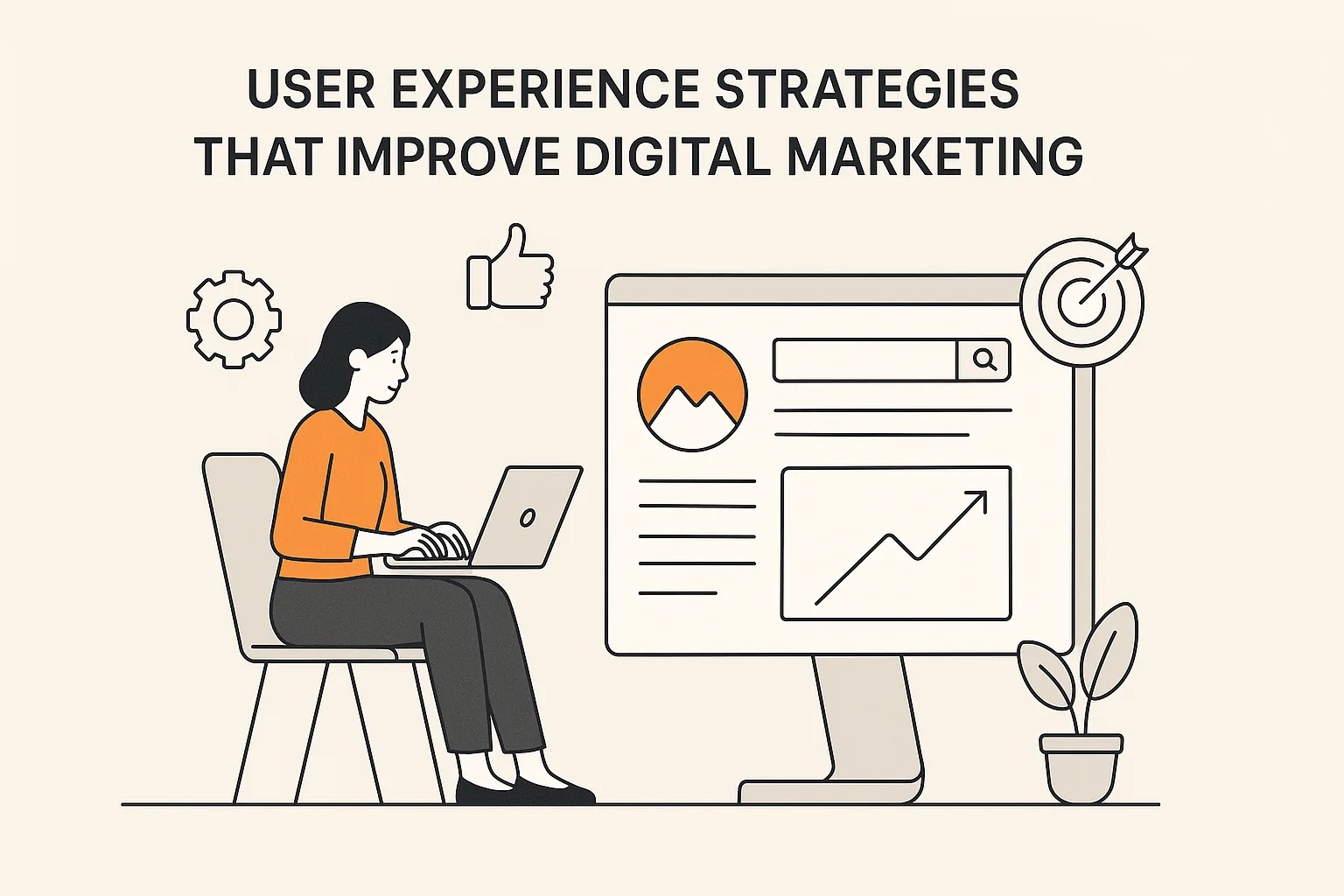
User Experience Strategies That Improve Digital Marketing
Strong digital marketing depends on more than traffic, ad spend, or content volume. If visitors arrive on your website and cannot quickly understand, trust, or act on what they find, campaigns underperform. That is where user experience becomes a direct marketing advantage.
A well-planned website helps people find information, compare options, complete forms, request quotes, and become customers with less friction. For businesses competing online, better usability often means stronger engagement, higher conversion rates, and more value from every marketing channel.
Why User Experience Matters in Digital Marketing
Digital marketing brings people to your website. User experience determines what happens next.
Paid ads, SEO, email campaigns, social posts, and referral traffic all lead users somewhere. If that destination is slow, confusing, outdated, or hard to use on mobile, the marketing investment loses impact. A visitor may click, scan for a few seconds, and leave before taking action.
Good user experience supports digital marketing by improving:
- Conversion rates from ads, organic traffic, and referrals
- Lead quality by making offers and forms clearer
- Search visibility through stronger engagement and technical performance
- Brand trust with polished design and consistent messaging
- Customer retention by making repeat visits easier
- Campaign ROI by reducing wasted traffic
According to Google Search Central’s guidance on page experience, site performance, mobile usability, secure browsing, and helpful content all contribute to how users experience a website. These factors also influence how effectively marketing campaigns perform once traffic arrives.
Align Website Strategy With Marketing Goals
A website should not be treated as a separate asset from your marketing plan. It should be built around the same business goals, audience needs, and conversion priorities.
Before redesigning pages or launching campaigns, identify the primary actions you want users to take. These may include:
- Requesting a quote
- Scheduling a consultation
- Calling your office
- Buying a product
- Signing up for a newsletter
- Downloading a resource
- Visiting a physical location
Once those actions are clear, user experience decisions become more focused. Page layouts, navigation, copy, visuals, forms, and calls to action should all support those goals.
For example, a service business running Google Ads should not send visitors to a generic homepage if the ad promotes one specific service. A targeted landing page with relevant copy, proof points, and a simple contact form will usually perform better.
If your site needs a stronger structure to support campaigns, STL Website Development provides custom website development services built around usability, performance, and business objectives.
Improve First Impressions With Clear Visual Design
People form opinions about websites quickly. Design affects whether visitors feel confident, confused, or skeptical.
A strong first impression does not require excessive animation or complicated layouts. In most cases, effective digital marketing benefits from clean, professional design that communicates clearly.
Focus on these visual design priorities:
- Use consistent colors, fonts, and spacing
- Keep page sections organized and easy to scan
- Use high-quality images that support the message
- Make buttons visually distinct
- Avoid cluttered hero sections
- Keep important information above the fold
- Maintain brand consistency across every page
Your logo, typography, and color system also influence trust. If your branding looks outdated or inconsistent, users may question the quality of your business before reading your content. STL Website Development offers professional logo design services that help create a stronger foundation for digital marketing and website credibility.
Make Navigation Simple and Predictable
Navigation is one of the most important parts of user experience. Visitors should not have to guess where to click or dig through confusing menus to find what they need.
Effective navigation is:
- Short
- Logical
- Consistent
- Mobile-friendly
- Focused on the user’s priorities
Most business websites do not need complicated menu structures. A simple navigation bar with clear labels often works best. Common pages include Services, About, Portfolio, Reviews, Blog, and Contact.
Avoid vague labels such as “Solutions” or “Resources” unless they are supported by clear dropdowns. Users should know what they will find before they click.
For mobile users, menus should open smoothly, links should be easy to tap, and contact options should be visible. If someone is ready to call from a phone, do not make them search for your phone number.
Use Content That Helps Users Take Action
Content is not just for search engines. It is one of the strongest tools for improving user experience and digital marketing performance.
Good website copy answers questions, addresses objections, and guides users toward a next step. Poor copy creates uncertainty. If users cannot quickly understand what you do, who you serve, and why they should choose you, they are less likely to convert.
Strong marketing-focused copy should:
- Lead with the user’s problem or goal
- Explain services in plain language
- Highlight benefits, not only features
- Include proof such as testimonials, results, or certifications
- Use clear calls to action
- Break content into scannable sections
- Avoid jargon unless your audience expects it
For example, instead of saying, “We provide comprehensive digital solutions,” say what the service actually does and why it matters. Specific copy builds confidence.
If your website needs clearer messaging, STL Website Development’s website copywriting services can help turn your services, value proposition, and calls to action into content that supports conversions.
H2: User Experience and Conversion Rate Optimization
Conversion rate optimization is the process of improving the percentage of visitors who take a desired action. User experience and conversion optimization work together because every point of friction can reduce results.
Common conversion barriers include:
- Forms that are too long
- Weak or unclear calls to action
- Slow-loading pages
- Distracting layouts
- Missing trust signals
- Unclear pricing or service details
- Poor mobile usability
- Broken links or errors
Improving conversions often starts with simplifying the path from interest to action. A visitor should always know three things:
- Where they are
- What information matters
- What to do next
Clear buttons such as “Request a Quote,” “Schedule a Consultation,” or “Call Today” usually outperform vague options like “Submit” or “Learn More” when the user is ready to act.
Placement also matters. Calls to action should appear at natural decision points throughout the page, not only at the bottom. For longer service pages, include multiple opportunities to convert after key sections.
H3: User Experience Starts With Mobile Performance
Mobile traffic is now essential to digital marketing. Many prospects first encounter a business through a mobile search, social media post, map result, or email link. If the mobile version of your site is difficult to use, you risk losing high-intent visitors.
Mobile user experience depends on:
- Fast load times
- Readable text without zooming
- Buttons large enough to tap
- Simple forms
- Sticky or easy-to-find contact options
- Proper spacing between clickable elements
- Layouts that adapt cleanly to different screen sizes
A mobile website should not feel like a squeezed-down desktop page. It should be designed for how people actually browse on phones: quickly, with limited patience, often while multitasking.
The Nielsen Norman Group defines usability around how easy and satisfying a design is to use. On mobile, that standard becomes even more important because small frustrations can quickly cause users to leave.
Speed Is a Marketing Advantage
Page speed affects user experience, search performance, and paid campaign efficiency. Slow websites create frustration and increase bounce rates. They can also reduce the effectiveness of landing pages used for ads and email campaigns.
Improving speed may include:
- Compressing images
- Reducing unnecessary scripts
- Using quality hosting
- Minimizing plugin bloat
- Caching pages
- Cleaning up code
- Loading fonts efficiently
- Testing performance regularly
Google’s Core Web Vitals provide useful benchmarks for load speed, interactivity, and visual stability. These metrics help identify technical issues that affect how users experience a page.
Even small performance improvements can make a meaningful difference. A faster website feels more professional, encourages users to keep browsing, and supports stronger digital marketing results.
Build Trust With Proof and Transparency
Marketing claims are easy to make. Trust is earned through proof.
Users want to know if your business is credible before they contact you, request pricing, or make a purchase. A strong user experience includes trust signals placed where they naturally support decision-making.
Useful trust elements include:
- Customer testimonials
- Case studies
- Portfolio examples
- Awards or certifications
- Years in business
- Industry memberships
- Before-and-after examples
- Clear contact information
- Team photos
- Secure website indicators
- Privacy policies and terms
Do not hide proof on a single testimonials page. Add relevant testimonials or project examples throughout service pages and landing pages. When users are evaluating a specific offer, proof should be close to the call to action.
Transparency also matters. If pricing varies, explain what affects cost. If your process has several steps, outline them clearly. If users know what to expect, they are more likely to move forward.
Match Landing Pages to Campaign Intent
Every digital marketing channel brings users with different expectations.
A visitor from an organic blog post may still be researching. A visitor from a paid search ad may be ready to contact a provider now. A visitor from an email campaign may already know your brand and need a direct offer.
User experience improves when landing pages match intent.
For paid search campaigns, landing pages should:
- Reflect the exact service or offer from the ad
- Use a direct headline
- Remove unnecessary distractions
- Include relevant proof
- Offer a clear next step
- Keep forms short
For SEO pages, content should be more comprehensive, answering common questions and helping users compare options. For email campaigns, pages can be more focused because the visitor already has context.
When the page aligns with the user’s reason for clicking, marketing performance improves.
Make Forms Easier to Complete
Forms are often where conversions fail. A user may be interested but abandon the process if the form looks too long, asks unnecessary questions, or does not work well on mobile.
To improve form user experience:
- Ask only for essential information
- Use clear field labels
- Make error messages specific
- Avoid resetting fields after errors
- Use dropdowns carefully
- Make phone numbers and emails easy to enter
- Confirm successful submission
- Explain what happens next
A service business usually does not need a long intake form as the first step. Name, contact information, service interest, and a short message are often enough to start a conversation.
Also consider offering more than one contact method. Some users prefer forms. Others prefer phone calls or direct email. Giving users options can improve lead volume and lead quality.
Accessibility Supports Better Marketing
Accessible websites are easier for more people to use. They also tend to be better organized, more readable, and more technically sound.
Accessibility improvements may include:
- Proper heading structure
- Sufficient color contrast
- Alt text for meaningful images
- Keyboard navigation support
- Descriptive link text
- Captions for video content
- Clear form labels
- Avoiding text embedded in images
The Web Content Accessibility Guidelines provide a recognized framework for building more accessible digital experiences.
Accessibility is not only a compliance concern. It is also a user experience and marketing issue. If visitors cannot read, navigate, or interact with your site, they cannot become customers.
Maintain the Website After Launch
User experience is not a one-time project. Websites need ongoing updates to remain secure, functional, fast, and aligned with marketing goals.
Over time, businesses change services, launch new campaigns, add content, update branding, and adjust offers. Without maintenance, websites can develop broken links, outdated plugins, slow pages, inaccurate information, and security issues.
Regular maintenance should include:
- Software and plugin updates
- Security monitoring
- Performance checks
- Broken link reviews
- Content updates
- Form testing
- Backup management
- Analytics review
- Mobile testing
STL Website Development offers website maintenance services to help keep websites reliable, secure, and ready to support digital marketing campaigns.
Use Analytics to Find Friction
You cannot improve what you do not measure. Analytics and user behavior data help reveal where users are dropping off, what content they engage with, and which pages support conversions.
Important metrics include:
- Traffic sources
- Bounce rate
- Engagement time
- Conversion rate
- Form submissions
- Click-through rates
- Exit pages
- Mobile versus desktop performance
- Page speed metrics
- Search queries
Tools such as Google Analytics, Google Search Console, heatmaps, and session recordings can help identify patterns. For example, if many users visit a service page but few contact you, the issue may be weak calls to action, unclear content, missing proof, or a confusing form.
The goal is not to collect data for its own sake. The goal is to make practical improvements that help users complete meaningful actions.
Create Consistency Across the Customer Journey
Digital marketing usually involves multiple touchpoints. A user may see an ad, visit a landing page, read reviews, browse service pages, sign up for emails, and then contact your business days later.
Consistent user experience across these touchpoints builds familiarity and trust.
Your messaging, visuals, offers, and tone should align across:
- Website pages
- Landing pages
- Email campaigns
- Social media posts
- Paid ads
- Google Business Profile
- Downloadable resources
- Sales follow-up materials
If an ad promises one thing but the landing page emphasizes something else, users may hesitate. If your website looks professional but your emails feel generic or inconsistent, trust can weaken.
A cohesive experience helps users feel confident that they are dealing with a credible, organized business.
Practical Checklist for Better User Experience
Use this checklist to identify quick improvements that can support your digital marketing:
- Is your primary call to action visible on key pages?
- Does your homepage explain what you do within a few seconds?
- Are service pages specific and easy to scan?
- Does your site load quickly on mobile?
- Are buttons easy to tap?
- Do forms ask only for necessary information?
- Is your navigation simple?
- Are testimonials or proof points visible?
- Is your branding consistent?
- Are broken links fixed?
- Is contact information easy to find?
- Are pages aligned with campaign intent?
- Is content written for users, not just search engines?
- Are accessibility basics covered?
- Is the site maintained regularly?
Small improvements can add up. Better usability often improves the results of SEO, paid advertising, email marketing, and social media without increasing traffic spend.
FAQ
How does user experience affect digital marketing?
User experience affects whether visitors stay, engage, trust your business, and take action. Strong usability can improve conversion rates, reduce bounce rates, support SEO, and make paid campaigns more profitable.
What is the most important user experience improvement for small business websites?
For many small businesses, the most important improvement is clarity. Visitors should quickly understand what you offer, who you serve, why they should trust you, and how to contact you.
Can better website design improve lead generation?
Yes. Better design can improve lead generation when it makes the site easier to navigate, strengthens trust, highlights calls to action, and supports clear messaging.
How often should a website be reviewed for usability?
A website should be reviewed at least quarterly, and any time you launch a new campaign, add a major service, update branding, or notice a drop in conversions.
Turn Better User Experience Into Better Marketing Results
Digital marketing does not end when someone clicks. The website experience that follows determines whether that visitor becomes a lead, customer, or missed opportunity.
By improving navigation, mobile performance, speed, copy, design, accessibility, trust signals, and conversion paths, your website can do more than look good. It can actively support business growth.
If your website is not converting the traffic you already have, STL Website Development can help. Contact STL Website Development today to build a stronger website experience that improves your digital marketing results.