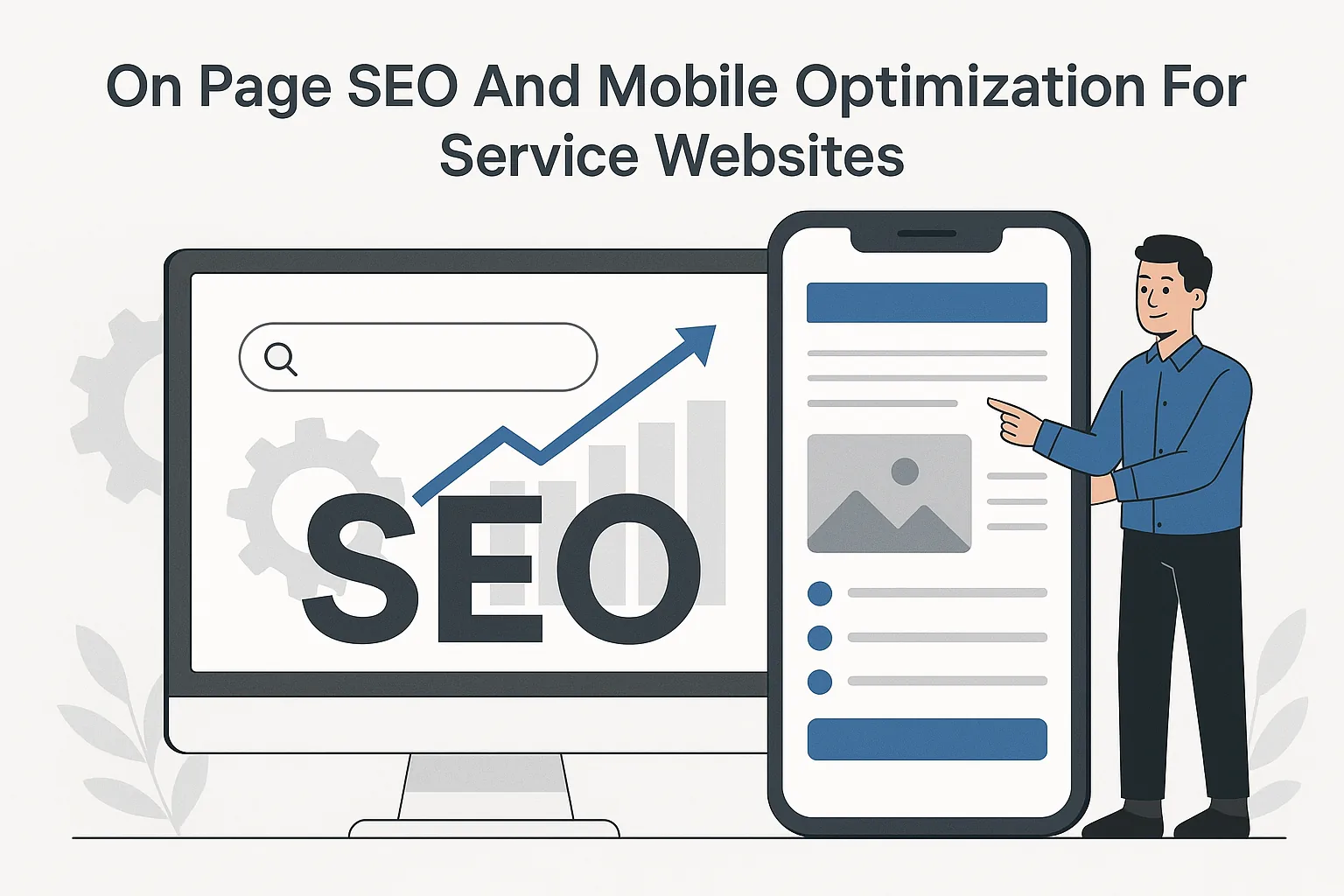
For service businesses, your website has one job: turn qualified visitors into leads. Strong on page seo and mobile optimization help make that happen by improving visibility, usability, speed, and conversion paths. When your pages clearly explain what you do, load quickly, work well on phones, and guide users toward contacting you, search engines and customers both have a better experience.
This guide explains how service websites can improve rankings and lead quality by aligning content, technical structure, mobile performance, and conversion design.
Why on page seo Matters for Service Websites
Service websites compete in a results-driven environment. Whether you are a contractor, attorney, medical provider, consultant, home service company, or local B2B firm, potential customers are comparing options quickly. They want answers, trust signals, and a simple way to take the next step.
on page seo is the process of optimizing individual website pages so they are easier for search engines to understand and more useful for visitors. It includes page titles, headings, internal links, content structure, image optimization, page speed, mobile usability, and calls to action.
For service businesses, this matters because your site needs to rank for searches with buying intent, such as:
- “roof repair company near me”
- “commercial HVAC service”
- “small business accountant”
- “web design company in St. Louis”
- “emergency plumbing service”
Search engines need to understand which services you provide, where you provide them, and why your page is relevant. Users need the same information, but presented clearly and quickly.
Good on page seo does both.
Mobile Optimization Is No Longer Optional
Most service searches now happen on mobile devices. A potential customer may be searching from a job site, car, office, or home. If your site is slow, hard to read, or difficult to navigate on a phone, visitors are likely to leave and contact a competitor.
Google also uses mobile-first indexing, which means the mobile version of your website is the primary version Google evaluates for indexing and ranking. Google explains this approach in its documentation on mobile-first indexing.
Mobile optimization affects:
- Search visibility
- User engagement
- Lead generation
- Bounce rates
- Form submissions
- Phone calls
- Brand trust
A service website should not simply “fit” on a phone. It should be designed to perform on a phone.
Core Elements of on page seo for Service Pages
Every important service page should be built around a clear purpose. A visitor should understand what the service is, who it is for, why your company is qualified, and how to contact you.
Page Titles and Meta Descriptions
The page title is one of the strongest on-page signals. It should include the main service, location if relevant, and your brand when appropriate.
Example:
Commercial Plumbing Services in St. Louis | Company Name
A good title is specific, readable, and aligned with search intent. Avoid vague titles like “Services” or “What We Do.”
Meta descriptions do not directly control rankings, but they influence clicks from search results. A strong meta description should summarize the value of the page and include a clear reason to click.
Example:
Need reliable commercial plumbing in St. Louis? Our licensed team provides repairs, maintenance, and emergency service. Request an estimate today.
Headings That Organize the Page
Headings help users scan the page and help search engines understand content hierarchy. Each page should usually have one clear H1, followed by logical H2 and H3 sections.
For example:
- H1: Commercial Plumbing Services in St. Louis
- H2: Plumbing Repairs for Businesses
- H2: Preventive Maintenance Plans
- H2: Why Choose Our Commercial Plumbing Team
- H2: Request Service
This structure makes the page easier to read and easier to crawl.
Service-Focused Content
Service pages should be specific. Thin pages with only a few sentences rarely perform well because they do not provide enough useful information.
A strong service page should explain:
- What the service includes
- Common problems the service solves
- Who the service is for
- Your process
- Benefits of choosing your company
- Service area details
- Frequently asked questions
- Next steps for contacting your team
Effective on page seo is not about stuffing keywords into weak content. It is about creating useful, complete pages that match what customers are searching for.
H3: on page seo Best Practices for Service Content
Service content should be written for real customers first. Search engines have become better at identifying whether a page actually satisfies user intent. That means clarity and usefulness matter.
Use these best practices:
- Include the primary service keyword naturally.
- Mention related services where relevant.
- Add location details if the page targets a local market.
- Use short paragraphs and clear subheadings.
- Include proof points such as certifications, years in business, reviews, or project types.
- Answer common objections before the visitor has to ask.
- Add strong calls to action throughout the page.
A page about “website maintenance,” for example, should not only say that maintenance is available. It should explain updates, backups, security monitoring, uptime support, content changes, and why ongoing care protects the client’s investment. STL Website Development offers professional website maintenance services for businesses that need their websites to stay secure, current, and reliable.
Internal Linking Helps Users and Search Engines
Internal links connect related pages on your website. They help visitors find useful information and help search engines understand page relationships.
For a service website, internal links should point users toward relevant next steps. For example, a page about search visibility may naturally link to custom website development services if the site needs structural improvements. A page about branding may link to professional logo design if visual identity affects trust and recognition.
Internal links should use descriptive anchor text. Avoid vague links like “click here.” Instead, use text that explains what the user will find.
Good examples:
- “custom website development services”
- “professional website maintenance services”
- “conversion-focused copywriting”
- “business logo design”
If your service pages are isolated, they are harder for users and search engines to understand. Smart internal linking supports stronger on page seo and a better user journey.
Mobile Optimization for Better Service Website Conversions
Mobile optimization is more than responsive design. A responsive layout is important, but conversion-focused mobile optimization also considers speed, tap targets, readability, navigation, forms, and calls to action.
Prioritize Fast Load Times
Mobile users are impatient, especially when they need a service quickly. If your page takes too long to load, many visitors will leave before reading anything.
Common causes of slow mobile pages include:
- Oversized images
- Too many scripts
- Heavy themes or page builders
- Unoptimized video
- Excessive plugins
- Poor hosting
- Render-blocking resources
Google’s PageSpeed Insights can help evaluate performance issues. While a perfect score is not always necessary, your website should load quickly enough to create a smooth experience.
For service businesses, speed directly affects leads. A visitor looking for emergency repair, legal help, or a quote request is unlikely to wait for a slow site.
Make Phone Calls Easy
Many service customers prefer to call. Your mobile website should make that simple.
Use:
- Click-to-call phone numbers
- Sticky mobile call buttons where appropriate
- Phone numbers in the header or top section
- Clear contact options near service descriptions
- Local phone numbers when relevant
Do not hide your contact information in the footer only. If a visitor is ready to call, reduce friction.
Simplify Mobile Forms
Forms should be easy to complete on a small screen. Long forms can reduce submissions, especially for first-time inquiries.
Mobile form best practices include:
- Ask only for essential information.
- Use large input fields.
- Use clear labels.
- Make error messages easy to understand.
- Enable autofill where possible.
- Avoid unnecessary dropdowns.
- Include a short privacy reassurance if appropriate.
For many service websites, a simple form with name, phone, email, service needed, and message is enough.
Content Quality and Search Intent
Search intent is the reason behind a search query. A visitor searching “how often should I maintain my website” is looking for information. A visitor searching “website maintenance company” is closer to hiring.
Your pages should match the intent behind the keyword.
Service pages should be built for commercial intent. Blog posts can answer informational questions and then guide users toward related services. This creates a stronger content ecosystem.
For example, a blog article about mobile performance can point users toward development, maintenance, and content services. If your website messaging is unclear, conversion-focused copywriting services can help turn traffic into better leads.
High-quality content should be:
- Accurate
- Specific
- Easy to scan
- Helpful
- Original
- Aligned with the user’s stage of decision-making
Google’s SEO Starter Guide reinforces the importance of helpful content, clear structure, and making pages understandable for both users and search engines.
Local Signals for Service Businesses
Many service companies depend on local visibility. If your business serves a specific city, metro area, county, or region, your website should make that clear.
Local on page seo improvements include:
- Adding city and region references naturally
- Creating dedicated service area pages when appropriate
- Including your business name, address, and phone number consistently
- Embedding a Google Map on the contact page if relevant
- Adding localized testimonials or project examples
- Mentioning neighborhoods or nearby communities when useful
- Using local business schema markup
Avoid creating dozens of low-quality location pages with nearly identical content. Each location page should be useful, specific, and written for the audience in that area.
Image Optimization for SEO and Mobile Speed
Images influence design, trust, and performance. Service websites often use project photos, staff images, equipment photos, portfolio examples, icons, and branded graphics. These assets should be optimized before publishing.
Best practices include:
- Compress images before upload.
- Use modern formats when appropriate, such as WebP.
- Add descriptive file names.
- Use meaningful alt text.
- Avoid uploading images much larger than needed.
- Lazy-load images below the fold.
- Use real images when possible instead of generic stock photos.
Alt text should describe the image accurately. It should not be stuffed with keywords. For example, “technician repairing rooftop HVAC unit” is better than “best HVAC repair HVAC company HVAC service.”
Better image handling supports mobile optimization and strengthens on page seo by improving accessibility, context, and load speed.
Technical Details That Support on page seo
A service page can have good content and still underperform if technical issues get in the way. Technical quality helps search engines crawl, index, and evaluate the page properly.
Important technical checks include:
- Clean URL structure
- Proper canonical tags
- Secure HTTPS
- XML sitemap
- Robots.txt configuration
- No broken internal links
- No duplicate title tags
- No missing H1 tags
- Proper redirects
- Schema markup where relevant
- Core Web Vitals performance
Core Web Vitals measure user experience signals such as loading performance, interactivity, and visual stability. Service websites should monitor these metrics because poor performance can affect both rankings and conversions.
Calls to Action That Convert
Traffic alone is not the goal. A service website needs calls to action that guide visitors toward becoming leads.
Effective CTAs are:
- Clear
- Specific
- Visible
- Relevant to the page
- Repeated at key points
- Easy to use on mobile
Examples:
- Request a Free Estimate
- Schedule a Consultation
- Call for Emergency Service
- Get a Website Review
- Contact Our Team
- Request a Quote
A CTA should not feel like an afterthought. It should be built into the page structure. After explaining the service, answering key questions, and showing trust signals, give the visitor a simple next step.
Trust Signals Improve Engagement
Users evaluate credibility quickly. If your site looks outdated, loads poorly, or lacks proof, visitors may hesitate.
Strong trust signals include:
- Reviews and testimonials
- Case studies
- Certifications
- Industry affiliations
- Before-and-after photos
- Team photos
- Clear contact information
- Years of experience
- Guarantees or warranties
- Secure website experience
Trust signals also support on page seo indirectly by improving engagement. When visitors stay longer, read more, and interact with your site, the page has a better chance of performing well over time.
Measuring on page seo and Mobile Performance
Optimization should be measured. Without tracking, it is difficult to know what is working.
Monitor:
- Organic traffic
- Keyword rankings
- Click-through rate
- Bounce rate
- Form submissions
- Phone call clicks
- Page speed
- Core Web Vitals
- Conversion rate
- Indexed pages
- Crawl errors
Google Search Console and Google Analytics are essential tools. Search Console shows how your pages appear in search, what queries drive impressions, and whether indexing issues exist. Analytics helps show what users do after they land on your site.
For service websites, the most important metric is not traffic alone. It is qualified leads.
Common Mistakes to Avoid
Many service websites struggle because the basics are incomplete or inconsistent.
Avoid these common issues:
- Using the same title tag on multiple pages
- Publishing thin service pages
- Ignoring mobile page speed
- Hiding phone numbers on mobile
- Using vague headings
- Writing only for search engines
- Forgetting internal links
- Using oversized images
- Allowing broken links to remain
- Having unclear CTAs
- Creating duplicate location pages
- Neglecting ongoing updates
Strong on page seo is not a one-time checklist. It should be reviewed as your services, competitors, and search behavior change.
FAQ
What is on page seo for a service website?
on page seo is the process of optimizing individual website pages so they are clearer, more useful, and easier for search engines to understand. For service websites, it includes service-specific content, headings, title tags, internal links, mobile usability, page speed, images, and calls to action.
How does mobile optimization affect leads?
Mobile optimization affects how easily visitors can read your content, call your business, complete forms, and navigate your site. If the mobile experience is slow or frustrating, users are more likely to leave before contacting you.
How often should service pages be updated?
Service pages should be reviewed at least a few times per year. Updates may be needed when services change, competitors improve their content, new FAQs arise, search rankings shift, or performance issues appear.
Do all service businesses need separate pages for each service?
In most cases, yes. Dedicated service pages give each offering a better chance to rank and make it easier for users to find exactly what they need. A single general services page is usually not enough for competitive search visibility.
Can better content improve mobile conversions?
Yes. Clear, concise content improves mobile conversions because users can quickly understand your service and take action. Strong headings, short paragraphs, bullet points, and visible CTAs are especially important on small screens.
Conclusion: Build Service Pages That Rank and Convert
Service websites need more than a good-looking design. They need clear structure, useful content, fast mobile performance, strong technical foundations, and conversion-focused calls to action. When on page seo and mobile optimization work together, your website becomes easier to find, easier to use, and more effective at generating leads.
STL Website Development builds and supports service websites designed for visibility, performance, and growth. If your site needs better rankings, faster mobile performance, stronger content, or a more effective conversion strategy, contact STL Website Development today to discuss your next steps.