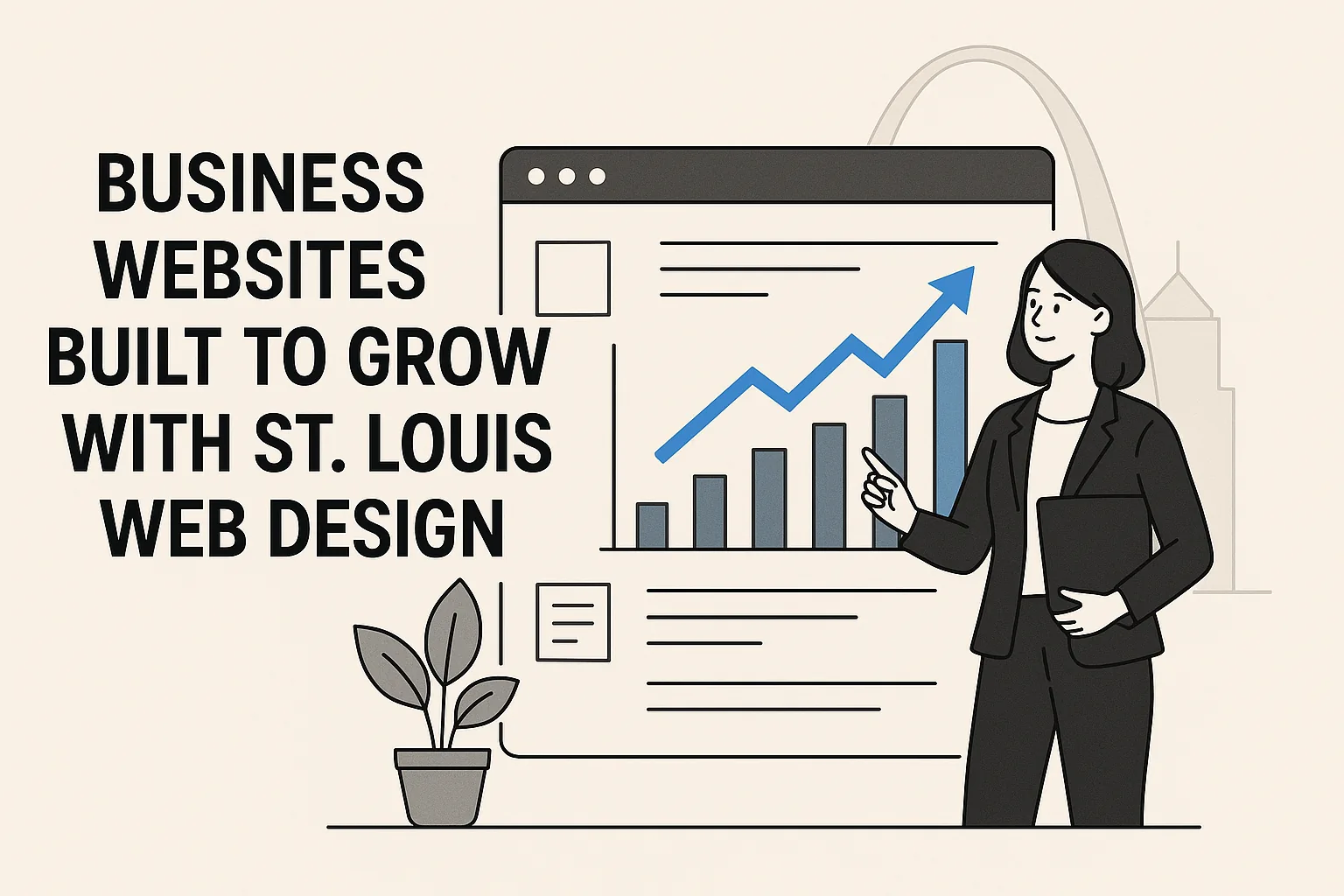
Business Websites Built To Grow With St. Louis Web Design
Growing companies need business websites that do more than look polished on launch day. Your website should help customers find you, understand your value, contact you quickly, and trust that your company can deliver. For St. Louis organizations, that means building with local market knowledge, strong technical foundations, clear messaging, and room to expand as your business grows.
At STL Website Development, we build websites with long-term performance in mind—not short-term design trends.
Why business websites need a growth-first strategy
Many companies start with a basic website because they “just need something online.” That may work for a short time, but it often creates problems later.
A growth-first website is different. It is planned around where your business is going, not only where it is today. Strong business websites should support new services, new locations, changing offers, updated branding, search visibility, lead generation, and customer trust.
A growth-first approach considers:
- How your customers search for your services
- What information they need before contacting you
- How your website will perform on mobile devices
- How pages can be added or updated over time
- How your site supports sales, hiring, marketing, and credibility
- How design, copy, SEO, and maintenance work together
If your website is hard to update, slow to load, confusing to navigate, or built without search visibility in mind, it can become a bottleneck instead of a business asset.
St. Louis web design should reflect how local customers make decisions
St. Louis is a relationship-driven market. Whether you serve customers in the city, St. Louis County, St. Charles County, Metro East, or throughout Missouri and Illinois, people want to know who they are doing business with.
Effective st louis web design should communicate professionalism while also making your company feel accessible and credible. Visitors should be able to quickly answer questions like:
- What does this company do?
- Do they serve my area?
- Have they worked with businesses like mine?
- Can I trust them?
- How do I contact them?
- What happens next?
Local relevance matters. Your website should include clear service areas, local proof points, accurate contact information, and content that matches how your audience searches. This is especially important for service businesses, contractors, professional firms, healthcare providers, restaurants, nonprofit organizations, and B2B companies serving the St. Louis region.
Core elements of business websites that grow
A website built for growth has more than attractive visuals. It needs a reliable structure, useful content, and technical quality. The best business websites combine strategy, design, development, and ongoing support.
1. Clear positioning and messaging
Your website should quickly explain what you do, who you help, and why customers should choose you. Visitors should not have to work hard to understand your offer.
Strong messaging includes:
- A clear homepage headline
- Service descriptions written in plain language
- Benefits that matter to the customer
- Calls to action on key pages
- Trust signals such as reviews, certifications, case studies, or project examples
If your messaging is vague, even a beautiful design will underperform. Professional website copywriting services can help turn your expertise into clear, persuasive content that supports search visibility and conversions.
2. Flexible website architecture
Growth requires flexibility. If you add new services, expand into new markets, publish resources, hire staff, or launch campaigns, your site should be able to support those changes without a complete rebuild.
A scalable structure may include:
- Individual service pages
- Location or service area pages
- Team or leadership pages
- Blog or resource sections
- Portfolio or case study pages
- Landing pages for campaigns
- FAQ pages
- Career pages
This structure helps users find relevant information and gives search engines more context about your business. Google’s Search Essentials emphasize helpful, people-first content, which aligns with building pages that answer real customer questions.
3. Mobile-first performance
Most customers will experience your website on a phone before they ever view it on a desktop. If your site is difficult to use on mobile, you risk losing leads.
Mobile-friendly business websites should have:
- Fast load times
- Readable text
- Tap-friendly buttons
- Simple navigation
- Forms that are easy to complete
- Click-to-call functionality
- Layouts that adapt cleanly across screen sizes
A mobile-first approach is not optional. It affects user experience, lead generation, and search performance.
4. Search-friendly development
Search engine optimization starts before content is published. It begins with how your website is built.
Search-friendly development includes:
- Clean code
- Proper heading structure
- Fast page speeds
- Optimized images
- Logical URL structures
- Schema markup where appropriate
- Secure HTTPS configuration
- XML sitemap and robots.txt setup
- Accessibility-conscious design
Our custom website development services focus on building sites that are easy to use, easy to manage, and ready to support long-term digital marketing.
5. Strong brand presentation
Your website is often the first serious interaction someone has with your brand. If your logo, colors, typography, imagery, and messaging feel inconsistent, visitors may question your credibility.
Consistent branding helps create recognition and trust. For new businesses or companies ready for a stronger visual identity, professional logo design and brand presentation can make your website and marketing materials feel more unified.
A strong brand system supports:
- Website design
- Business cards and print materials
- Social media graphics
- Signage
- Email marketing
- Proposals and sales documents
Your website should feel like the center of your brand, not a disconnected piece of marketing.
How st louis web design supports lead generation
A successful website should guide visitors toward action. That may mean calling your office, filling out a quote request, scheduling a consultation, downloading a resource, or visiting your location.
Lead-focused business websites are built around customer intent. Someone visiting a service page may be ready to contact you. Someone reading a blog post may still be researching. Your site should support both.
Key lead generation features include:
- Prominent phone numbers
- Simple contact forms
- Service-specific calls to action
- Trust-building testimonials
- Clear pricing guidance when appropriate
- Easy navigation to important pages
- Fast-loading pages
- Live chat or inquiry options when useful
Good design reduces friction. It makes the next step obvious without overwhelming the visitor.
H3: business websites need content that answers real questions
Content is one of the biggest differences between a brochure website and a growth-focused website. Customers search because they have questions. Your website should answer those questions better than your competitors do.
Helpful content can include:
- Service explanations
- Buying guides
- Industry insights
- Maintenance tips
- Comparison pages
- Frequently asked questions
- Case studies
- Local resource pages
For example, a contractor may need pages for specific services and service areas. A law firm may need practice area pages and attorney bios. A manufacturer may need capability pages, equipment information, and industry applications.
The goal is not to publish content for the sake of content. The goal is to create useful pages that help visitors make informed decisions and help search engines understand your expertise.
Accessibility and usability matter for every business
Accessible websites are easier for everyone to use. Accessibility is not only about compliance; it is about making sure more people can navigate, read, and interact with your content.
Important accessibility considerations include:
- Proper color contrast
- Keyboard navigation
- Descriptive link text
- Alt text for meaningful images
- Clear form labels
- Logical heading order
- Captions or transcripts for video content when needed
The Web Content Accessibility Guidelines from W3C provide a widely recognized framework for building more accessible digital experiences. For business owners, accessibility also improves usability, professionalism, and customer reach.
Why ongoing maintenance is part of growth
Launching your website is not the finish line. It is the starting point.
Technology changes. Plugins need updates. Content becomes outdated. Security risks evolve. Search expectations shift. If your website is ignored for months or years, performance and credibility can suffer.
Ongoing maintenance helps protect your investment. It may include:
- Software and plugin updates
- Security monitoring
- Backups
- Broken link checks
- Performance reviews
- Content updates
- Form testing
- Analytics review
- Technical troubleshooting
Professional website maintenance and support gives your company a reliable partner after launch. That matters when you need quick updates, new pages, security fixes, or technical help.
Signs your current website is holding you back
Not every website needs to be rebuilt immediately. But if your current site creates friction for users or limits your marketing, it may be time to improve it.
Common warning signs include:
- Your site looks outdated compared to competitors
- It loads slowly
- It is difficult to use on mobile devices
- You cannot easily update content
- Your services are unclear
- You are not receiving quality leads
- Your contact forms are unreliable
- Your site does not rank for relevant searches
- You have inconsistent branding
- Important pages are missing
- You are embarrassed to send prospects to your website
Modern business websites should help sales conversations, not create doubt before a prospect contacts you.
Building business websites with scalability in mind
Scalability is not only for large companies. Small and mid-sized businesses also need websites that can adapt.
A scalable site makes it easier to:
- Add new service pages
- Expand into new locations
- Publish educational content
- Launch paid advertising landing pages
- Feature new team members
- Update testimonials and case studies
- Improve SEO over time
- Connect with CRM, email, or scheduling tools
- Support recruiting and hiring
When scalability is planned from the beginning, your website can grow in stages. You do not have to build everything at once, but you do need a structure that supports future improvements.
This is where experienced st louis web design makes a measurable difference. A local team can understand your market, your competitors, and the practical needs of your customers while building a site that supports long-term goals.
What the STL Website Development process focuses on
A strong website project should be organized, strategic, and transparent. At STL Website Development, our process focuses on aligning design and development with your business objectives.
A typical project may include:
Discovery and planning
We learn about your company, customers, services, competitors, and goals.Site structure and strategy
We define the pages, navigation, calls to action, and content needs.Design direction
We create a visual approach that reflects your brand and supports usability.Content development
We help organize and refine messaging so each page has a purpose.Website development
We build the site with performance, responsiveness, and usability in mind.Testing and launch
We review functionality, mobile layouts, forms, speed, and technical setup.Ongoing support
We help keep the site updated, secure, and ready for future growth.
The result is not just a website that looks good. It is a digital platform designed to support visibility, credibility, and action.
Common features that help business websites perform
Every company has different needs, but many high-performing business websites include similar features.
Consider adding:
- Service pages with clear calls to action
- A strong homepage value proposition
- Testimonials or reviews
- Project galleries or case studies
- Team bios
- Contact forms with spam protection
- Click-to-call phone numbers
- Google Business Profile links or map embeds
- Blog or resource content
- Newsletter signup forms
- Analytics and conversion tracking
- Accessibility improvements
- Secure hosting and backups
The right features depend on your customers and goals. A local restaurant, construction company, medical practice, nonprofit, and B2B service firm will each need a different website strategy.
FAQ
Why do business websites need more than a good design?
Good design is important, but it is only one part of a successful website. Business websites also need clear messaging, mobile performance, search-friendly structure, strong calls to action, security, and ongoing updates. A polished site that does not generate trust or leads is not doing enough for your company.
How often should a business website be updated?
Most websites should be reviewed at least monthly for software updates, security, broken links, form functionality, and content accuracy. Larger content and SEO improvements should be reviewed quarterly or whenever your services, staff, pricing, or business goals change.
What makes st louis web design different for local companies?
Local design strategy considers how people in the St. Louis area search, compare, and choose providers. It also helps your site communicate local trust through service areas, local examples, relevant messaging, and clear contact options.
Can an existing website be improved without rebuilding it?
Sometimes, yes. If the site has a solid foundation, improvements may include better content, faster performance, stronger calls to action, updated branding, or technical SEO fixes. If the platform is outdated, difficult to manage, or poorly structured, a rebuild may be the better long-term option.
How long does it take to build a growth-focused website?
Timeline depends on the size and complexity of the project. A smaller business website may take several weeks, while larger sites with custom content, advanced functionality, or many service pages may take longer. A clear plan at the beginning helps keep the project efficient.
Build a website that can grow with your business
Your website should not be a static brochure that slowly becomes outdated. It should be a practical, professional platform that helps customers find you, understand your value, and take the next step.
Growth-focused business websites combine strategy, design, development, content, branding, and maintenance. When those pieces work together, your website becomes a stronger asset for marketing, sales, recruiting, and customer trust.
If your current site is limiting your growth—or if you are ready to build a new website with a stronger foundation—STL Website Development can help. Contact STL Website Development today to discuss a St. Louis web design project built around your goals, your customers, and your next stage of growth.